AI vs. Human Receptionist: Best Choice for Business?
AI receptionist, Home Services, Business Operations
AI vs. Hiring a Receptionist: What’s Better for Your Business?
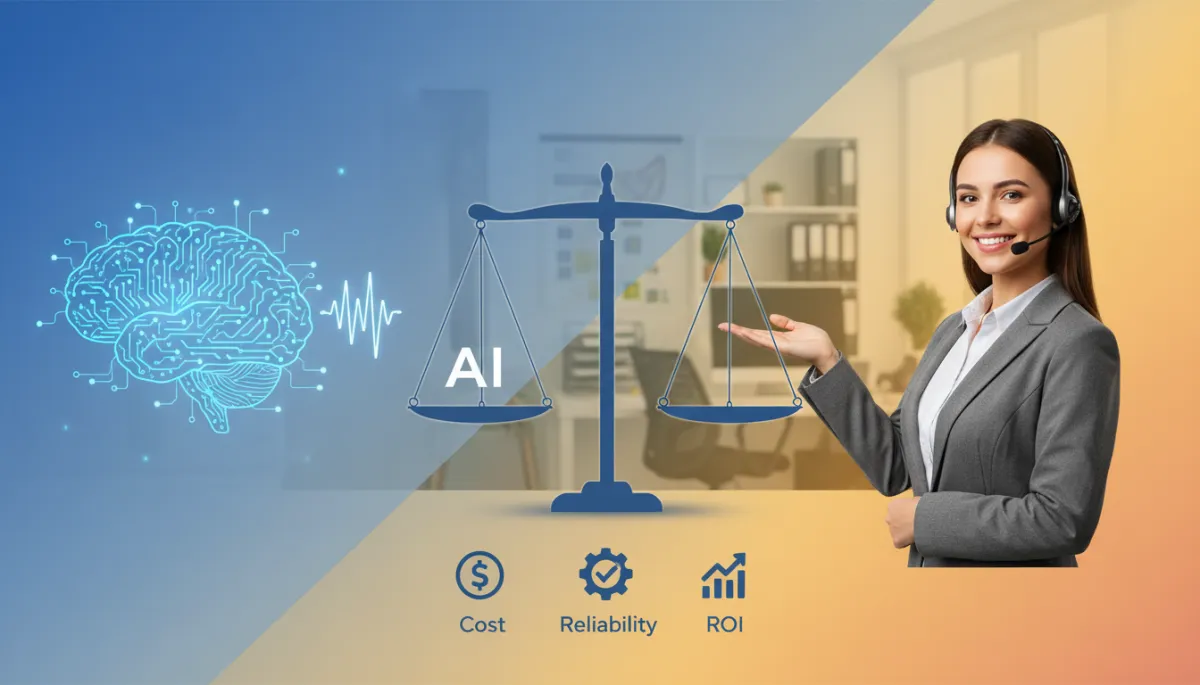
For home service business owners, every missed call can mean a lost job. As AI-powered phone systems mature, many owners are asking whether an AI receptionist or a full-time human receptionist delivers better value. This article takes a balanced, data-driven look at cost, reliability, and ROI so you can decide what fits your operation best.

Cost Comparison: What Are You Really Paying For?
Let’s start with the most visible part of home service business costs: payroll. In many U.S. markets, a full-time receptionist earns between $35,000 and $45,000 per year in base salary. Once you add payroll taxes, benefits, training, and workspace, the fully loaded cost often lands in the $45,000–$55,000 range annually for a single 40-hour-per-week receptionist.
By contrast, a modern virtual receptionist or automated answering service using AI typically follows a subscription or usage-based pricing model. Industry data on AI interactions suggests that AI-handled calls can cost in the range of roughly $0.50–$2.00 per interaction, compared with $8–$12 for human-only support (aiapps.com). For a home service company handling a few hundred calls per month, that can translate to a few hundred dollars in AI costs instead of thousands in fixed payroll.
It’s also important to factor in coverage. A single human receptionist usually covers business hours only. If you want evenings, weekends, or overflow support, you either pay overtime, hire additional staff, or send calls to voicemail. An AI receptionist, on the other hand, is available 24/7 without incremental labor costs, which can significantly reduce the effective cost per answered call during off-hours and peak seasons.
Reliability: Who Answers When It Really Matters?
For owners of plumbing, HVAC, electrical, or cleaning companies, reliability is not just about being polite on the phone; it’s about consistently capturing every lead. Human receptionists bring strengths: they can read emotion, improvise, and build rapport. But they also take breaks, get sick, go on vacation, and can only handle one caller at a time. During a storm or heat wave, when calls spike, even your best receptionist will miss calls or send people to voicemail.
Modern AI voice systems have evolved significantly. Agentic voice AI can now answer with sub‑500 millisecond latency and maintain natural conversation flows, according to recent 2026 voice AI trend reports (pathors.com, getperspective.ai). For home service businesses, that means an AI receptionist can answer every call on the first ring, 24/7, and handle many calls in parallel—no busy signals, no voicemail black hole, and no “I’ll call them back later” that never happens.
That said, reliability is not just uptime; it’s also accuracy. AI still struggles with heavily accented speech, noisy environments, or highly unusual requests. This is why many of the most effective systems use a hybrid model: an AI receptionist handles routine calls—quote requests, scheduling, rescheduling, basic FAQs—and hands off complex or emotional situations to a human team member. Nextiva and other providers note that this AI-to-human handoff is now standard in modern answering services, balancing cost-efficiency with quality.

Call analytics from AI receptionists reveal peak times, missed calls, and booking rates in real time.
ROI: How Do AI and Human Receptionists Impact Revenue?
Return on investment comes down to two questions: how many jobs do you win, and what does it cost you to win them? Studies of lead response show that businesses responding within five minutes are up to 21 times more likely to qualify a lead than slower responders (famulor.io). For home service companies, that often means the first provider to answer the phone or call back wins the job. An always-on AI receptionist can materially improve your speed-to-answer at all hours, which directly influences revenue.
On the cost side, AI and virtual receptionist solutions typically generate ROI through three levers:
- Lower handling cost per call compared with human-only reception, especially at scale.
- Higher lead capture by answering off-hours and overflow calls that would otherwise be missed.
- Better scheduling efficiency through direct integration with calendars and CRMs, reducing no-shows and double-bookings.
Human receptionists, however, can still provide strong ROI in specific contexts. For high-ticket jobs—such as full HVAC system replacements or major remodeling—having a skilled person who can qualify leads, reassure anxious homeowners, and upsell service plans can increase average ticket size and close rates. Entrepreneur and Forbes both note that the decision between virtual and human receptionists often hinges on how much your business depends on deep, relationship-based selling versus fast transactional booking.
AI vs Human Receptionist: Which Is Better for Home Service Businesses?
For many home service companies, the most practical answer to AI vs human receptionist is not “either/or” but “both/and.” AI excels at being fast, consistent, and cost-effective. A human receptionist shines when empathy, complex problem-solving, or nuanced brand representation is required. In 2026, leading automated answering services blend the two: AI handles the bulk of routine calls, while humans step in for edge cases and high-value conversations.
How to Decide What’s Right for Your Business
To choose the right mix for your operation, start with data:
- Analyze your call volume by hour and day to see when you miss the most calls or send people to voicemail.
- Estimate the average revenue per booked job and the lifetime value of a new customer to quantify the cost of missed calls.
- Compare the annual fully loaded cost of a receptionist to realistic subscription and usage fees for an AI or virtual receptionist platform.
From there, you can model different scenarios: AI-only, human-only, or a hybrid approach where an automated answering service covers nights, weekends, and overflow while a human receptionist handles daytime and complex calls. The right choice will depend on your market, pricing, and growth goals—but the numbers increasingly favor giving AI a central role in your call handling strategy.
Next Step: See the Numbers for Your Business
If you’d like a data-driven projection of how an AI receptionist could impact your specific home service business costs, bookings, and ROI, you don’t have to guess. You can walk through your call volume, service mix, and revenue targets with a specialist and get concrete numbers, not just theory.
Book a free strategy call today at dreamvista.ai/strategy-call to see what a modern AI receptionist could do for your business.
